
In New York, every commercial pesticide application needs a use record with the EPA registration number, product name, quantity used, date applied, address with five-digit ZIP code, dosage rate, method of application and target organism, kept for at least three years. On top of the records, commercial applicators file an annual report with the Department of Environmental Conservation (DEC) on or before February 1 for the prior calendar year. The law is ECL §33-1205(1), as explained in DEC's own OGC-3 guidance.
This is a plain-English summary, not legal advice. We last reviewed the New York citation for our state profile on September 4, 2026, and re-read DEC's OGC-3 guidance on November 11, 2026. Rules change, so confirm with your state agency, DEC, before you rely on this page. Our short profile of the same rule is at /compliance/new-york.
New York is different from most states in one way that matters: it does not only ask you to keep records, it asks you to send them in once a year. That makes the quality of every single record show up on a deadline, not just during an inspection.
What must a New York pesticide use record include?
Under ECL §33-1205(1), as listed in our state profile and in DEC's OGC-3 guidance, each record for each pesticide application includes:
- The EPA registration number.
- The product name.
- The quantity of each pesticide used.
- The date applied.
- The location of application by address, including the five-digit ZIP code.
- The dosage rate.
- The method of application.
- The target organism.
The "place" rule most people miss
DEC's OGC-3 guidance adds one more thing. Its regulations also ask for the place of each application, and DEC reads "place" as more specific than the street address. Its examples are "Apartment 5" of a building, or the "kitchen of restaurant" at an address. The stated aim is that someone could return to the site and identify the exact location of the application.
OGC-3 says DEC accepts records kept under §33-1205(1) as meeting its regulatory recordkeeping rules as long as the place is included in every record. So an address alone is not enough. Write where on the property the product went: the unit, the room, the crawl space, the perimeter of the building.
Read the OGC-3 guidance in full before you design a form around this list. Our summary covers the core fields; the guidance is what DEC applies.
How long do New York pesticide records have to be kept?
At least three years. OGC-3 says the records are maintained on an annual basis, retained for at least three years, and must be available for inspection when DEC asks. The records behind each annual report are kept for at least three years too.
Three years is longer than the federal floor. Under 40 CFR Part 171, certified applicators keep restricted-use pesticide records for 2 years. New York's rule covers every commercial application, not only restricted-use products, and for longer.
If you change software, the duty stays with you. Export your records before you cancel anything. How to switch pest control software covers what to export first.
What is the New York annual pesticide report?
Under ECL §33-1205(1), all commercial applicators file an annual report with DEC on or before February 1 for the prior calendar year. OGC-3 says the report consists of the pesticide use records for each application, with:
- EPA registration number
- Product name
- Quantity of each pesticide used
- Date applied
- Location of application by address, including the five-digit ZIP code
Notice what that means. The report is not a summary you write once a year. It is your records, one row per application, sent to the state. A gap in January's records is a gap in next February's report.
OGC-3 also clears up an old overlap. DEC's regulations once set a January 15 report date; the guidance says a single annual report meeting the statute satisfies both, and the February 1 date governs. DEC's annual report form is 44-15-26.
How do you file the New York annual report, step by step?
Here is the yearly routine, in the order it actually happens:
- Close out December. Every December application needs its record before you start. Chase any open jobs in the first week of January.
- Pull every record for the calendar year. January 1 to December 31, all applicators, all products.
- Check every row for the report fields. EPA registration number, product name, quantity, date, address and five-digit ZIP. A missing quantity is the most common hole, because many states never ask for it.
- Check the EPA number is the registration number. Not the establishment number printed near it on the label. How to read an EPA registration number shows the difference.
- Convert to the form's format. The state form uses its own units and county codes, so your records need converting rather than pasting as they are.
- Fill in DEC's form 44-15-26 and submit it on or before February 1.
- Keep a copy and the records behind it for at least three years.
Budget real time for steps 3 to 5 the first year, especially if your records were never structured.
Template: a New York pesticide use record
Use these columns whether you keep records on paper, in a spreadsheet or in software. The example row is made up.
| Field | Why it's there | Example |
|---|---|---|
| Date applied | Statute and report | 2026-06-14 |
| Address with 5-digit ZIP | Statute and report | 12 Example Ave, Albany NY 12210 |
| Place on the property | OGC-3 "place" | Basement crawl space and exterior perimeter |
| Product name | Statute and report | As printed on the label |
| EPA registration number | Statute and report | Company and product number from the label |
| Quantity used | Statute and report | Total applied, with its unit |
| Dosage rate | Statute | Rate from the label you used |
| Method of application | Statute | Compressed air spray, bait, dust |
| Target organism | Statute | German cockroach |
| Applicator | Who to ask, and who the report rows belong to | Name and certification number |
The applicator column is not in the statute list above, but you will want it. When DEC asks a question about a record, you need to know who to ask. Our free chemical application record template has a printable version with the common fields; add the place and quantity columns for New York.
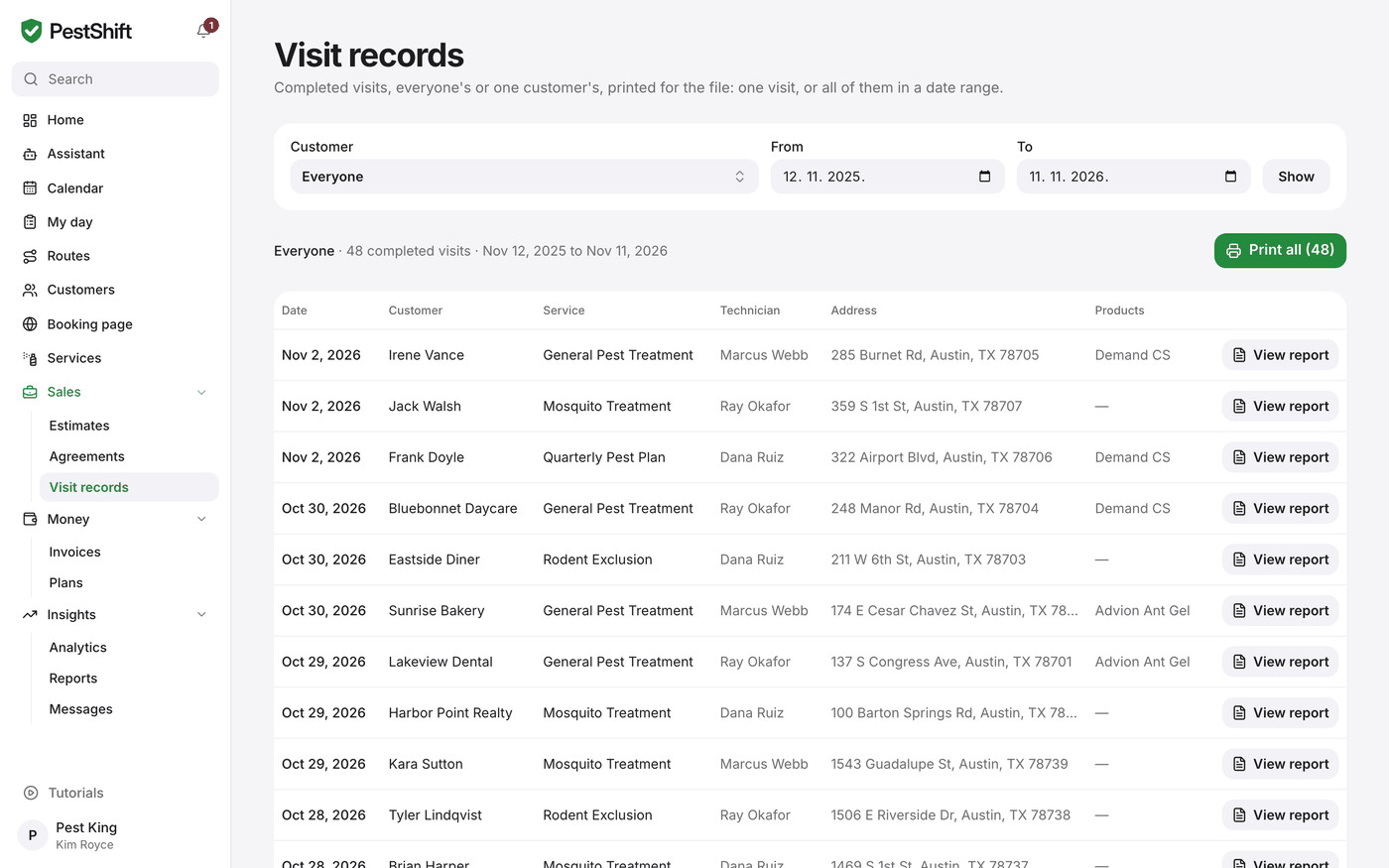 Completed visits and the products applied, for any date range. (demo data)