
In Illinois, a commercial structural pest control business keeps a record of every pesticide application for at least two years. Each record names the customer or application site and its address, the technician who applied the pesticide, the date and time, the target pest or purpose, and the pesticide used, including the product and its EPA registration number. The rule is 77 Ill. Adm. Code 830.820, part of the Structural Pest Control Code.
This is a plain-English guide, not legal advice. We last reviewed the Illinois citation in our state profile on September 4, 2026, and checked the Illinois Department of Public Health pages linked below on November 11, 2026. Rules change, so confirm the current requirements with the Illinois Department of Public Health before you rely on this page. Our short profile of the same rule is at /compliance/illinois.
Who regulates pest control records in Illinois?
In most states the pesticide regulator is the department of agriculture. In Illinois, for structural pest control, it is the Illinois Department of Public Health (IDPH) licenses structural pest control business locations, routinely inspects them, certifies technicians by examination and investigates pesticide misuse.
Three IDPH points shape how an Illinois shop keeps records:
- A license needs a certified technician. IDPH says a business must employ at least one certified technician before it can get a license. That certified technician is also the person responsible for reviewing records written by uncertified staff (more on that below).
- Certification is renewed every three years. IDPH's page says certification must be renewed by December 1, every 3 years, to avoid late fees. Our post on pest control license requirements explains how licensing is structured across states.
- Inspections are routine. IDPH describes routinely inspecting licensed locations, so keep records ready to hand over on any day.
What must an Illinois pesticide application record include?
Our state profile of §830.820 lists five items for each record:
| Field | What to write | Common gap |
|---|---|---|
| Customer name and address, or site of application | The customer and the full service address, plus the site if it differs | A route sheet that shows only the street name |
| Name of the technician applying the pesticide | The person who actually applied it, not the account owner | The supervisor's name on a helper's job |
| Date and time of application | Both. Illinois asks for the time, not just the day | Date only, with no time |
| Target pest or purpose | "German cockroach", "rodent exclusion", "termite pretreatment" | "General service" |
| Pesticide use | Product brand or common name and the EPA registration number, plus the other details the rule lists | The EPA establishment number copied by mistake |
Two details stand out against other states. First, the time of application is part of the record, so a record that only shows a date is incomplete. Second, the pesticide-use line is more than a product name. IDPH's summary of the 2015 amendments says the estimated amount of pesticide recorded on service records must be accurate to within 10 percent of the actual amount applied. "Some" or "as needed" will not meet that.
Read subsection (d) of §830.820 in full before you design a form. It spells out exactly how the pesticide use is recorded and how restricted-use and general-use records are organized, and the rule text is what an inspector checks against, not our summary. If the EPA registration number is a source of confusion on your team, pesticide application record keeping explains how to read it off a label.
How long do Illinois pesticide records have to be kept?
Two years, under §830.820, for each commercial structural pest control business location. That matches the federal floor in 40 CFR Part 171.107, which requires certified applicators to keep restricted-use pesticide records for 2 years. The difference is scope: the federal rule covers restricted-use applications only. Record duties for general-use products come from state law, so read §830.820 itself for what it covers.
IDPH's amendment summary adds one more retention rule that is easy to miss: on-the-job training records for an employee are kept for as long as that person works for you, or until they become certified. If you are hiring, that file starts on day one. See how to hire your first pest control technician for the rest of that process.
Who has to review records written by uncertified technicians?
This is the Illinois rule most small shops have never heard of. Under §830.820, the certified technician responsible for using pesticides, or for overseeing their use by non-certified personnel, documents a review of all pesticide records for services performed by uncertified technicians. The documentation is the reviewer's name, certification number and the dates of service reviewed.
IDPH's amendment summary says the language was changed to allow review of electronic records, by having the certified technician declare that responsibility on a single document. That document is IDPH's Statement of Service Record Review. On it, the certified technician certifies they will review the service records at the location, for all technicians or for listed routes or technicians, over a stated period. The form notes the review period should be no more than one year.
A review routine that works for a small shop:
- Fill in the Statement of Service Record Review at the start of each year, listing the technicians or routes covered.
- Once a week, the certified technician opens every record written by an uncertified technician that week.
- For each record, check the five fields, the time, and that the amount looks right for the job.
- Fix gaps the same week, while the job is fresh.
- File the signed statement with your records so an inspector can see it next to them.
What extra records do termite jobs need in Illinois?
For termite control treatments, the record includes a diagram showing foundation types and accurate dimensions of all portions of the structures being treated. IDPH's amendment summary says this applies to pre-treatments, post-treatments and re-treatments using a termiticide, and that the diagram must be part of the service record.
A diagram that holds up shows each part of the structure with its dimensions, the foundation type of each section (slab, crawl space, basement) and where you treated. A clear photo of a neat hand sketch, attached to the job, beats a perfect drawing left in a truck. Our termite inspection report post has a diagram checklist you can reuse.
Do customers get a copy of the record?
On request, yes. IDPH's amendment summary says a business must provide copies of service records when the serviced property's current owner, manager or tenant asks. A tenant can ask, not only the owner, so keep records findable by address.
Free Illinois pesticide record template
Copy this into your own form or spreadsheet. One record per application.
| Field | Entry |
|---|---|
| Business name and location | |
| Customer name | |
| Service address (site of application, if different) | |
| Technician who applied the pesticide | |
| Technician certified? (yes / no) | |
| Date of application | |
| Time of application | |
| Target pest or purpose | |
| Product brand or common name | |
| EPA registration number | |
| Amount of finished product used (estimate within 10 percent) | |
| Other pesticide-use details required by §830.820(d) | |
| Restricted-use or general-use product | |
| Areas treated | |
| Termite job? Diagram attached (foundation types, dimensions) | |
| Reviewed by certified technician (name, certification number, date) |
The "other details" row is deliberate: add any line subsection (d) lists that your form lacks. For a general, multi-state version of this form, see our chemical application record template.
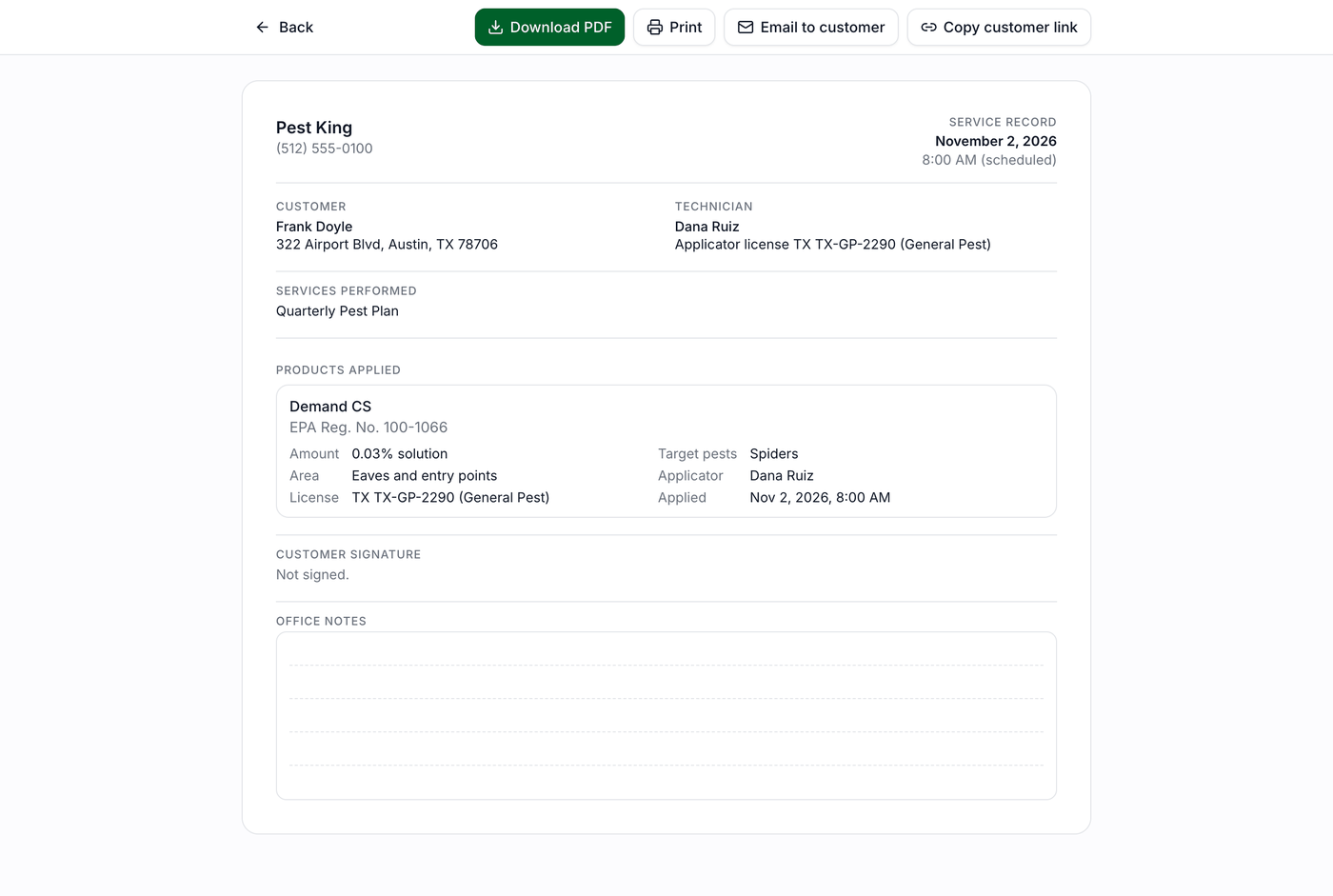 The application record for one visit in PestShift. (demo data)